
033. In Your Own Time
Thoughts on the timelines of our lives, and the threads that find us.

I’m sitting in my first beginner’s pottery class in Portland, Maine. An old brewhouse turned ceramics studio tucked downtown in this small port city.
High, concrete ceilings surround us. Damp, grey light from an overcast sky pouring through the closed glass-panelled garage door to my right. Mist beads softly on the crystal clear panes. I hear the gulls perched on the rooftop calling out into the cool breeze, and I smile at the smell of ocean in the air. Salt and seaweed, things living and things decaying. These are the sights, sounds, and smells of Maine.
We are a small group, just six women in total, and our instructor, Becca. I settle in at my wheel, unboxing the starter tool kit I purchased for the class. Ribbing tools for shaping and smoothing, I learn. A set of wire cutters for portioning and transferring, a sponge, a ruler, a recycled yogurt container to hold water — the lifeblood of wheel throwing.
The last time I sat behind a potter’s wheel I was eighteen in high school art class. Anticipation, uncertainty, and dreams flung out before me. Here now, behind a potter’s wheel again at thirty-four, anticipation, uncertainty, and dreams still shimmer in my vision. Some old and some new, at times a little foggy, but present all the same.
Some dreams, like threads I thought would tie themselves into neat little bows by now, stretching out, guiding me on. I place my hands on the threads, feel them taut between my fingertips today. They are not always like this; so confidently leading me forward, from the place I stand to the place I’m going. I’ve found that sometimes, the threads go slack for awhile. And sometimes, I just set them down altogether.
Today the threads are unyielding, full-force, straight ahead.
I grab ahold of them with renewed purpose.
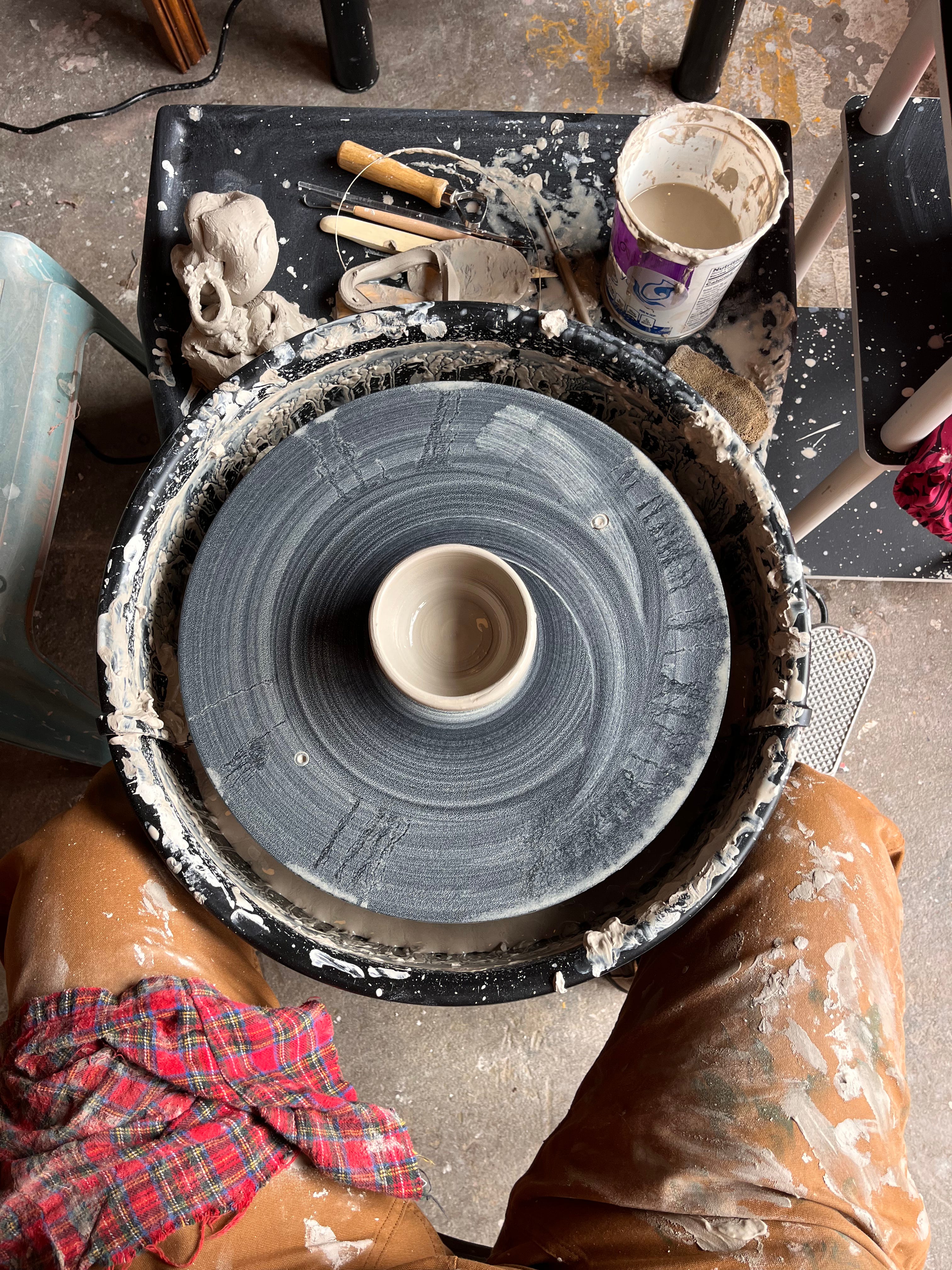
Becca’s first lesson for us is on centering. The process of adding a wedged ball of clay to the dampened bat of your wheel, and working the clay to create an even, stable distribution before pulling your piece.
Using my wire tool, I pull a small slab of clay from the twenty-five pound bag. The force of wedging, or rolling and folding the cool clay, exposing air bubbles and forming a small, fist-sized ball, holds it’s own somatic release.
A patch of tartan cloth draped over my left knee, I scoot to the edge of my chair and slap the mound of clay as close to the center of the motionless wheel as I can. Grabbing a soaked sponge, I dribble a cool cascade of water onto the wedge and the wheel begins to spin. I lean into the process. Quite literally.
I hear Becca’s voice instructing, “Don’t let the clay throw you around. Strong elbows, strong arms, firm hands.” I do as she says, my body communicating a confidence I definitely do not have yet when it comes to this medium. Cupping the mound of clay with my left hand, the edge of my right palm pushes down on the clay with intention. Before a pot can be opened, the potter must center the clay, bring evenness and consistency to the form. If an uncentered pot is opened, there will come a point in the process of pulling up walls where things start to get wonky — too thick here, not enough clay here, wobbly-lipped pot incoming.
Today, I don’t make any pots to leave behind drying on the shelf with my name printed on a strip of masking tape. Today, I center a first, then a second, then a third mound of clay for the majority of class. One classmate throws three beautiful mugs and a bowl in the same sitting. We come to the wheel with different experience, different encounters, different skill levels, and we make what we can, today. Each of us, arriving just when we should. Each of us, following a thread.
There is a poem I love by William Stafford, The Way It Is. These words first found me at a time when I did not know the way to go. And they have continued to find me, one hundred times over, when I begin to feel untethered or realize I’ve lost my threads.
THE WAY IT IS by William Stafford

There's a thread you follow. It goes among
things that change. But it doesn't change.
People wonder about what you are pursuing.
You have to explain about the thread.
But it is hard for others to see.
While you hold it you can't get lost.
Tragedies happen; people get hurt
or die; and you suffer and get old.
Nothing you do can stop time's unfolding.
You don't ever let go of the thread.
I like what William Sieghart has to say when commenting on Stafford’s poem in his book, The Poetry Pharmacy, “When people rediscover the thread that runs through their story, it is often a revelation. They are no longer directionless; suddenly, their narrative has the potential for a fitting ending — or for continuation down a previously unseen path.”
Something about mud. Something about moving out of my head and into my body as my fingers partner with reclaimed earth, and water assists in shifting shapes within my hands. Something about believing in the magic of making.
Maybe, the clay’s first lesson for me is about what might happen when I remember to center myself. To pull the loose bits back to the middle. The peel away the extra and keep only what is needed. To do this as many times over as I need, to keep following the thread.