
017. Creativity Inspires Creativity
Thoughts on Intermodal Creativity in Expressive Arts Therapy & Crystallization Theory (get in nerds).

I grew up making. When I was little, I remember collecting sticks and leaves and pink petals from beach roses to build fairy houses at my grandparent’s cottage on Maine’s mid-coast. I would tuck them in and around the vegetable gardens for my grandfather to stumble upon while collecting zucchini and rhubarb. The aroma of beach roses still transports me back to the barefoot summers of my youth (wow, how old am I?).
When I was nine or ten, my mom bought me a pad of giant paper, almost as tall as I was, and just short of my wingspan in width. She handed me a fresh set of colored sharpies. Spreading myself across our living room floor I would draw for hours. Music filled the atmosphere. Giant raindrops and flowers, sunlight and tall grasses, beachball-sized butterflies, trees, and ocean waves took shape. The art was a mirror reflecting my inner world to the outside; the places and things I dreamed about and loved, finding their way from thought to created image and form.
Making has followed me into adulthood, thank god.
Throughout my 20’s I found myself painting portraits of people I met on my travels and scrawling words in languages new to me onto old wood pallets I dragged home from people’s roadside garbage (to my two roommate’s dismay). I bought a crowbar and mallet to pull them apart in our dining room. With a staple gun and about a trillion staples I’d reassemble them (no idea why I was not using nails), paint them, turn them into art and line the walls of our home with them. Making something new out of something discarded felt like a way to add to the world as I was finding my own place in it.
In my 30’s I’m still a maker, still painting and drawing and writing. I now write poetry and prose and keep a journal. I learned how to play the Bodhrán and have been picking up guitar. I went through a soap-whittling phase (never made it to actual wood), and want to take wood-working and glass blowing classes. I recently started linocutting and love the tactility of it. I am so interested in trying new things creatively; gaining new insight and discovery as I stretch my creative imagination. Though, I focus most of my creative time on painting.
When I paint, I understand myself more clearly. Often, it is the process itself that brings clarity. The color mixing, the scribbling of sketches, the layers upon layers of media compressing together, the scraping and splashing, the adding and subtracting. It’s the process that helps me understand a bit more about who I am, the world I’m in, whatever is on my mind.
Have you ever looked at a piece of art and thought, “Wow, that artist must have been going through it,” or “this feels sad,” or “those colors together make me think of …” or “these lines and shapes remind me of…”
Art has the power to evoke emotion, understanding, curiosity, and clarity.
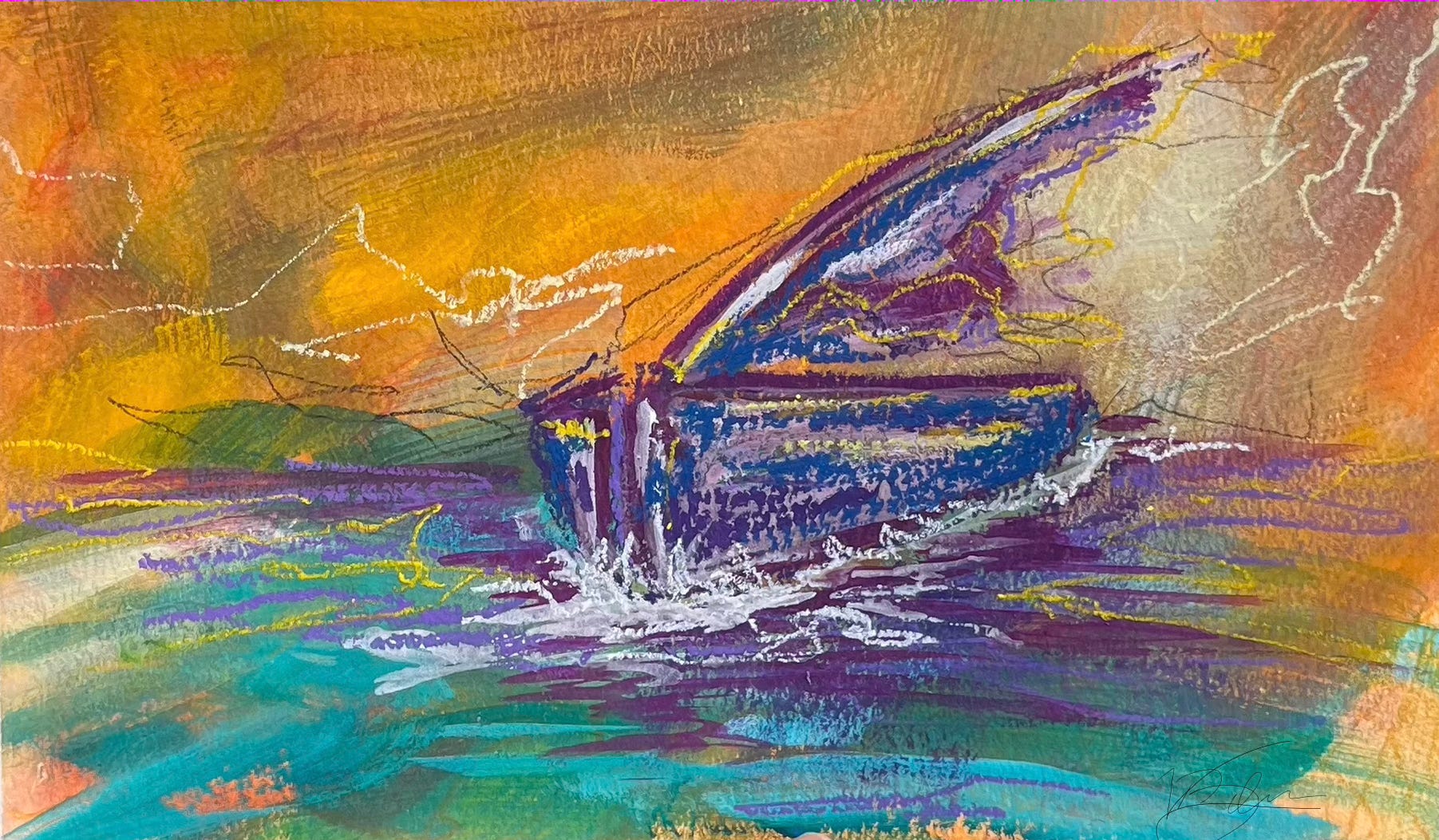
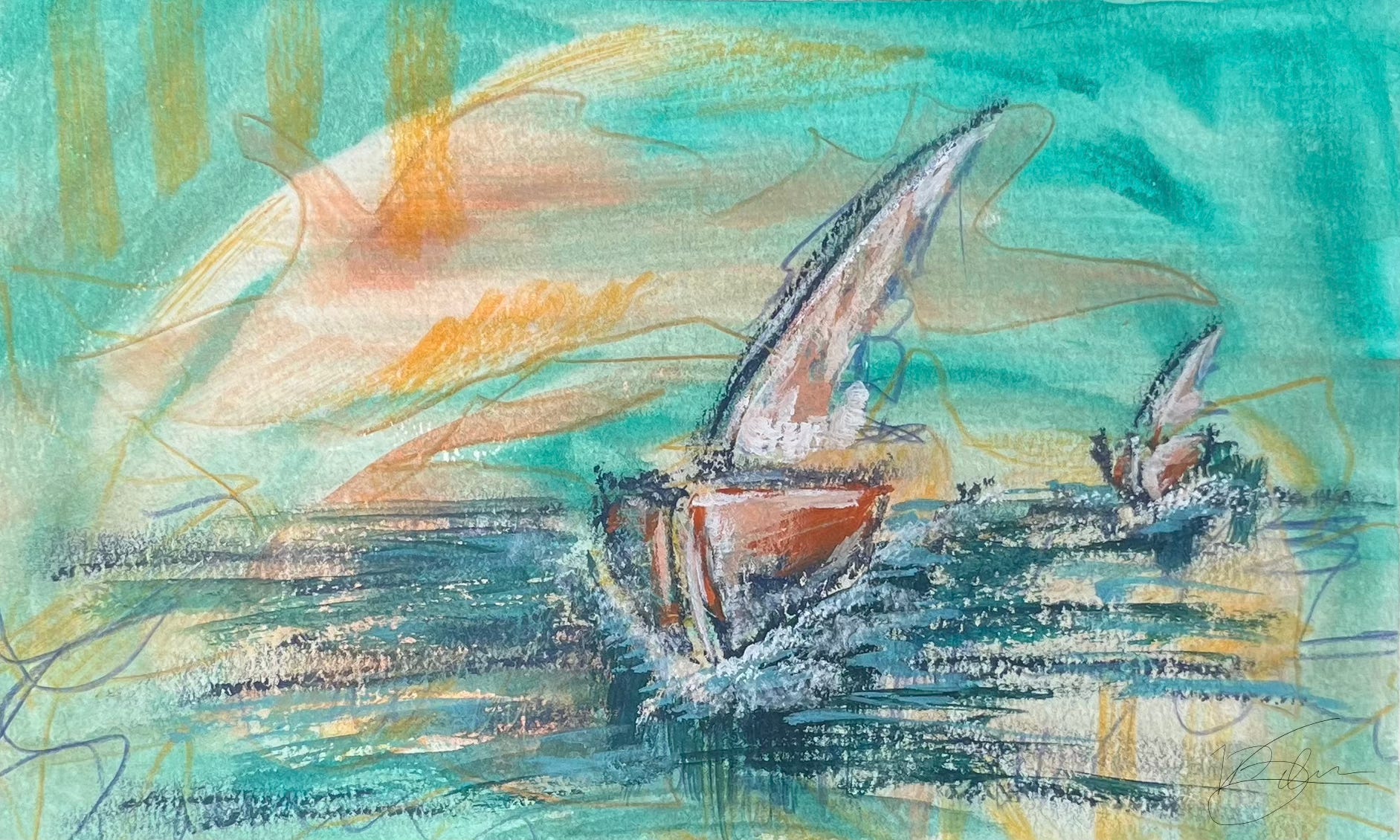
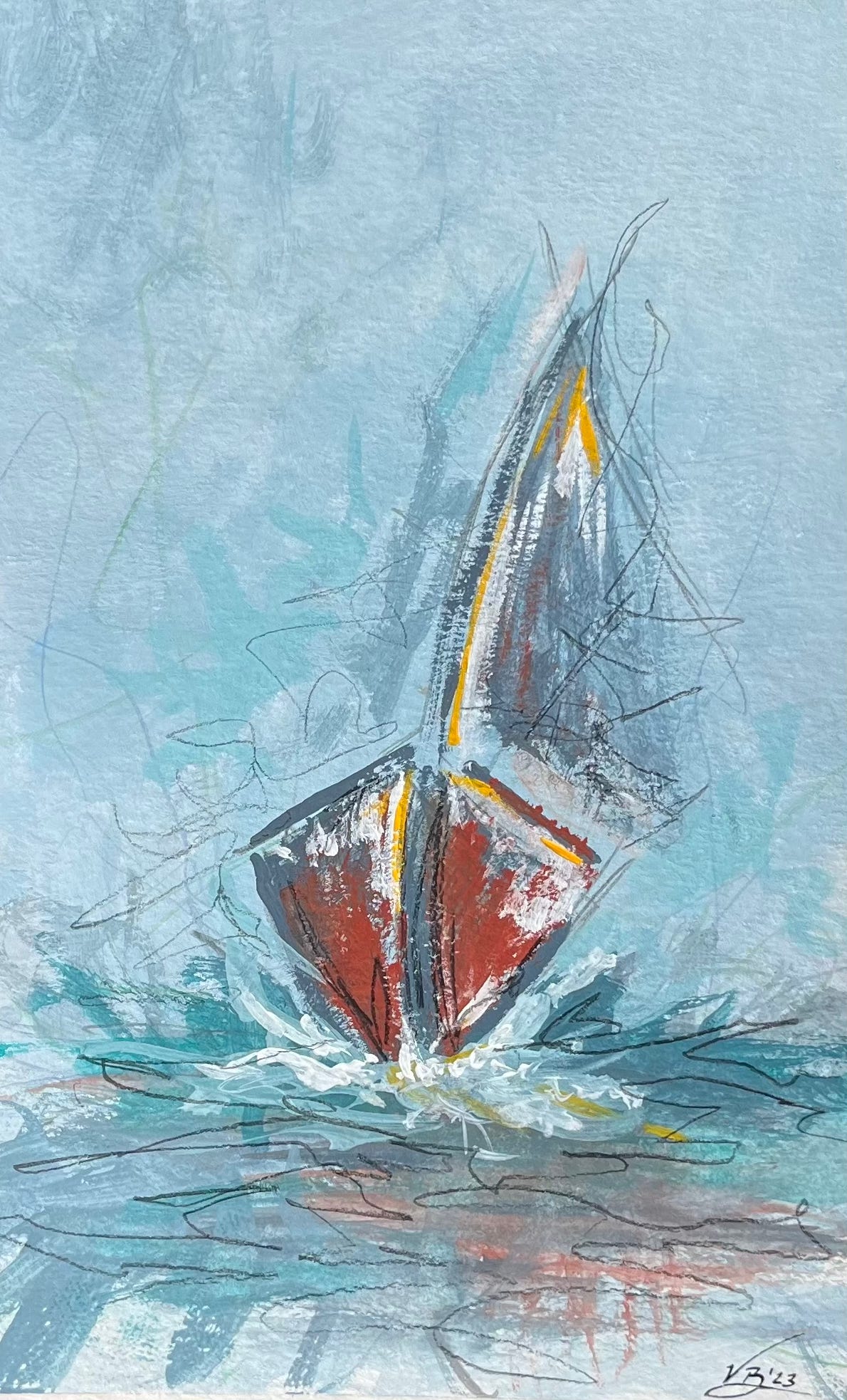
I have been thinking a lot about this recently as I revisit a series of boat sketches I did last summer. Thinking about art bringing us closer to clarity.
When I painted the boats, I had just moved back to Boston after living in Seattle for two years. I was back in a familiar place but felt like a different person. It’s hard to return changed, when so much about the place and the people you are returning to feels the same. My life was full of transition and movement at the time. I felt unsure of my footing.
I started painting again. No plan, just putting paint to paper. Lots of scribbling and abstraction. I tried not to linger too long on anything, out of caution for becoming fixated. I painted on paper instead of canvas for this reason. I could sense I just needed to keep moving, keep uncovering. I was reading a lot of poetry at the time, too. Lucille Clifton’s poem, Blessing the Boats, was on repeat:
Blessing the Boats
may the tide
that is entering even now
the lip of our understanding
carry you out
beyond the face of fear
may you kiss
the wind then turn from it
certain that it will
love you back
may you open your eyes to water
water waving forever
and may you in your innocence
sail through this to that
As the days went on and I continued my creative practice I began to notice my abstract paintings merging with the imagery of boats. While painting I would sometimes write out lines of the poem on the paper, or even phrases —“kiss the wind,” “love you back,” — to be covered by the first layer of colored pencil and acrylic wash. The poem became a part of the paintings, and the paintings began to reflect my experience of moving across the country, feeling unanchored. Of life in motion at that moment in time, of holding on to hope that change was good.
Of sailing through this to that.
In Expressive Art’s Therapy, there’s this theory called “Crystallization.” In their book Minstrels of Soul: Intermodal Expressive Therapy (2004), Barb, Fuchs, and Knill define crystallization as:
Crystallization Theory: “the basic human need or drive to crystallize psychic material; that is to move towards optimal clarity and precision of feeling and thought. When material is effectively crystallized, we experience it as being fitting, clear, right, and true” (p.30).
Crystallization is the natural human desire to make sense of and understand what we are experiencing.
I’ve completed year one of three in a graduate program for a Master’s degree in Clinical Mental Health Counseling Expressive Arts Therapy (a mouthful). Which I like to describe simply as “everything about talk therapy PLUS integrating creativity in the form of writing, poetry, drama, art, dance, music etc to aide in the therapeutic process.” I love this program. I love what I’m learning. I love the idea of intentionally bringing the arts into spaces of healing and discovery and transformation. It’s something I have naturally done my whole life and when I was 28 I found out it’s a legit social science.
In therapy jargon, we sometimes talk about interventions being intermodal, meaning integrating more than one modality (avenue or type) of therapeutic process together. It’s the idea that with each added layer of creative expression — sound, poetry, writing, dance, movement, drama — the participant is uncovering information and being guided towards greater understanding of themselves, their circumstances, their environment. Intermodal practice can guide us towards crystallization.
It’s like the boat sketches.
A layer of poetry, meets a layer of abstract painting (colors and shapes and lines), meets the imagery of sailing ships. I lay the finished images out on my dinning room floor, 12 in total, taking them in. I consider the phrases, “I see, I feel, I wonder…” I sit cross-legged on the floor and begin filling journal pages with responses to the art in front of me. As I write I notice themes. Threads of meaning weaving their way from my heart, to my mind, to the page. Crystallization.
I take a deep breath, set down the pen, lay on my back, let out a loud exhale.
I thank the art for showing me what I could not see before.
And I thank Lucille Clifton for making her art, without which my art might not exist, and my soul might feel a little less anchored, my spirit a little less understood.
Art inspires art. Creativity inspires creativity. Keep making, friends.

Beautiful writing and paintings Victoria!
Gorgeous words, inspiring others in the process. Loved reading this. And I think I was born making too (my mum used to say I was always ‘cutting and sticking’ ✂️ ❤️) xx